麺のことなら全てお任せください
 テレビ
テレビ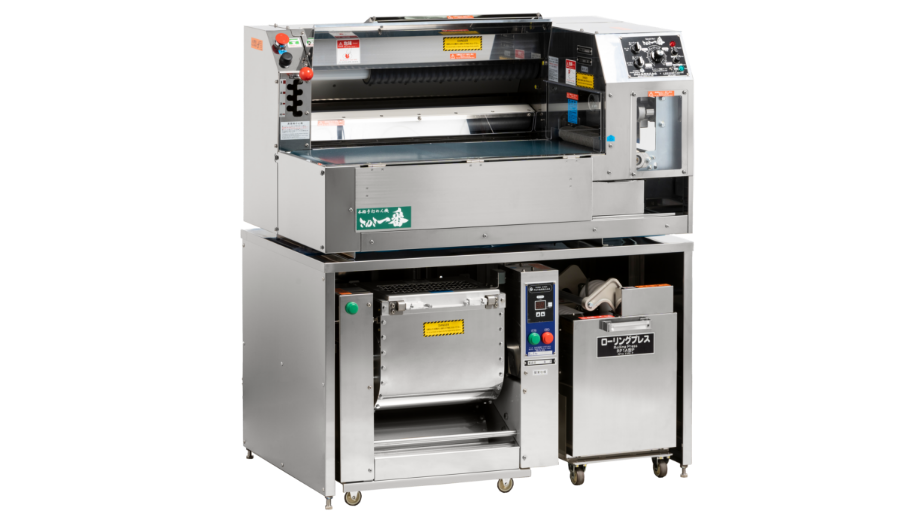
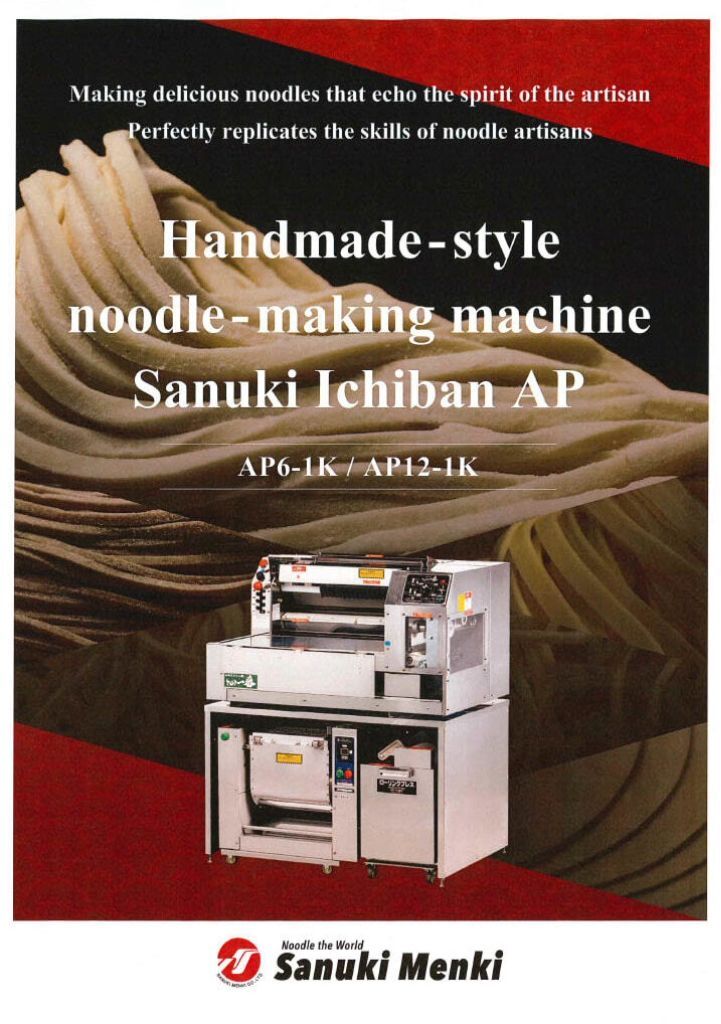
Sanuki Ichiban AP
An all-in-one handmade-style noodle machine that faithfully reproduces traditional handmade techniques. Includes a Super Kneader, Rolling Press, and noodle machine (Sanuki Ichiban), covering every step of the handmade noodle-making process.
Compatible Noodle Types
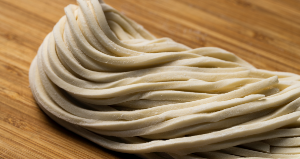
Udon
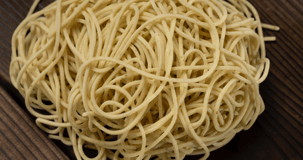
Ramen
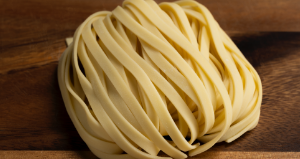
Pasta
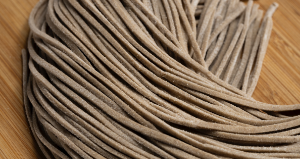
Soba
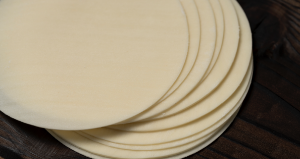
Gyoza wrappers
Noodle-Making Process
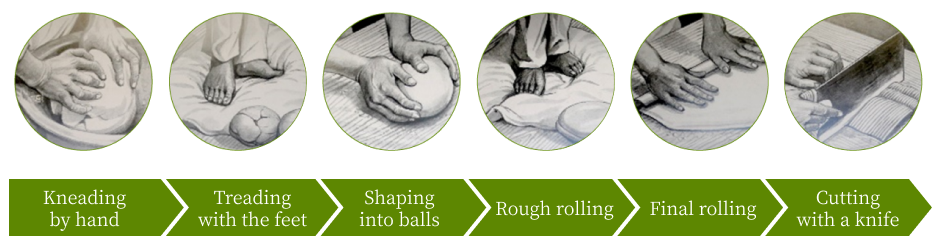
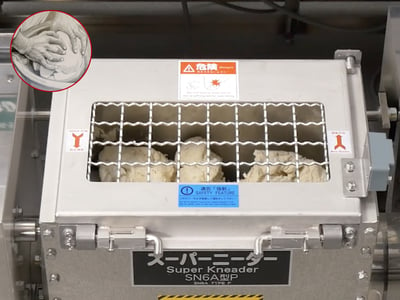
Kneading (Neri)
Kneading is so fundamental that it is said to determine the quality of the noodle. Saltwater draws out the maximum potential of the flour's gluten, and the dough is kneaded slowly at ultra-low speed to avoid damaging the gluten structure. Our proprietary blade mechanism faithfully replicates hand-kneading by creating zones of pressure and release. Because our kneader improves the rate at which saltwater is absorbed by the flour, both resting and boiling times are reduced.
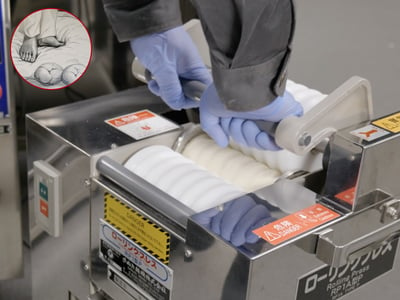
Foot Kneading
The kneaded dough from the previous step is repeatedly compressed to complete the hydration process. Since gluten develops its strongest elasticity when force is applied from all directions, kneading and foot-pressing are performed in one continuous motion. A roll that replicates the contoured surface of the arch, toe, and heel of a foot applies pressure while rotating in 4 directions, promoting gluten formation deep into the dough and bringing the surface to a smooth finish. The key is to apply gradual pressure equivalent to a person's body weight (approximately 60 kg), without damaging the dough structure.
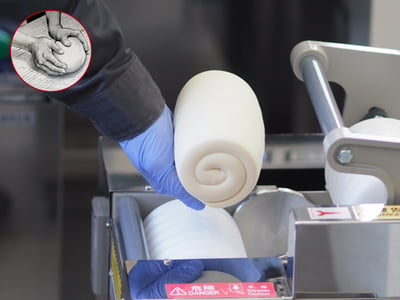
Dough Ball Forming
Forming the dough ball is an indispensable step that plays a critical role in the processes that follow. The rested and relaxed dough is thoroughly worked through kikumomi (chrysanthemum kneading), reactivating the gluten network and building an even stronger mesh-like structure. By applying pressure while rotating the dough, the kikumomi effect reaches all the way to the interior. Because the rested dough is softer and easier to shape, the result is a smooth, fine-textured dough ball.
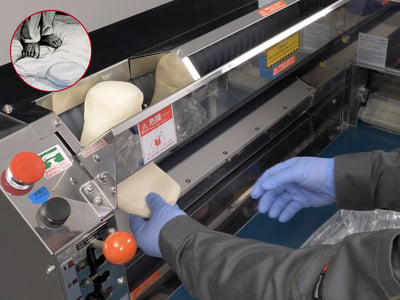
Rough Stretching
The wave roll — born out of the foot-kneading prohibition ordinance and synonymous with Sanuki Menki — was originally used to gently soften straw and was later adapted for conditioning noodle dough. The rough stretching performed with this corrugated roll is not simply about making the dough thinner. By changing direction — lengthwise, widthwise, and diagonally — through kneading and twisting actions, gluten is activated and the mesh-like structure is further strengthened. The spring mechanism also helps distribute pressure evenly, preventing damage to the gluten network.
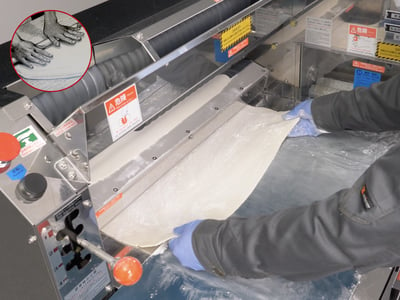
Finishing Stretch
The dough is stretched alternately lengthwise and widthwise along the gluten network, resulting in udon with a soft, chewy texture. Because the rolls are made of resin, the appropriate level of slip replicates the effect of the "sukashi-uchi" technique — a stretching method unique to Sanuki — using a rolling pin. Rather than thinning the dough all at once, it is gradually thinned in up to 9 adjustable stages, making it easy to achieve a uniform thickness.
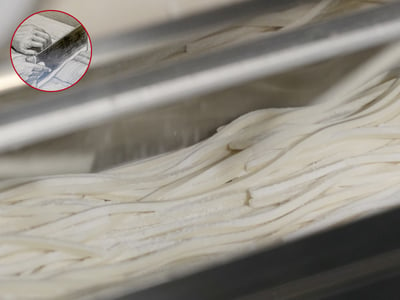
Knife Cutting
Using the same drawing-cut principle as slicing sashimi, this method differs from the push-cut technique — which can damage the dough structure — by cutting without disruption, achieving sharp, well-defined edges that also enhance texture. Compatible with ultra-high-hydration noodles, it operates quietly, causes minimal blade wear, and allows adjustment to your preferred noodle width.